You want consistency? You want production? You want numbers that make even the Hall of Fame’s inner circle flinch?
Then you want Albert Belle.
From 1992 to 2000, Albert Belle drove in 100 or more runs every single season—nine years in a row. Let that marinate for a second. Nine straight seasons of triple-digit ribbies. In modern baseball, we act like 100 RBI is a badge of honor. For Belle, it was just another Tuesday.
How rare is that kind of sustained dominance?
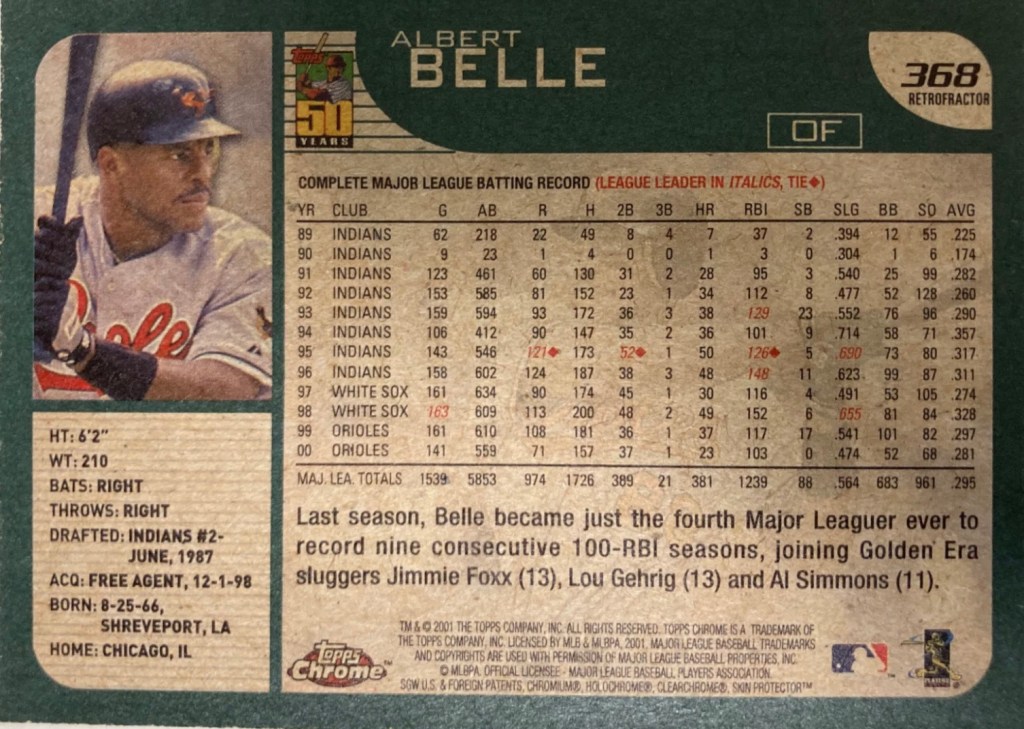
Take a look at the back of this 2001 Topps Chrome card. That’s right, in 2000–on the verge of retirement from osteoarthritis in his hips— Albert Belle became just the fourth player in MLB history to do it. The only others? Just a couple of names you might’ve heard:
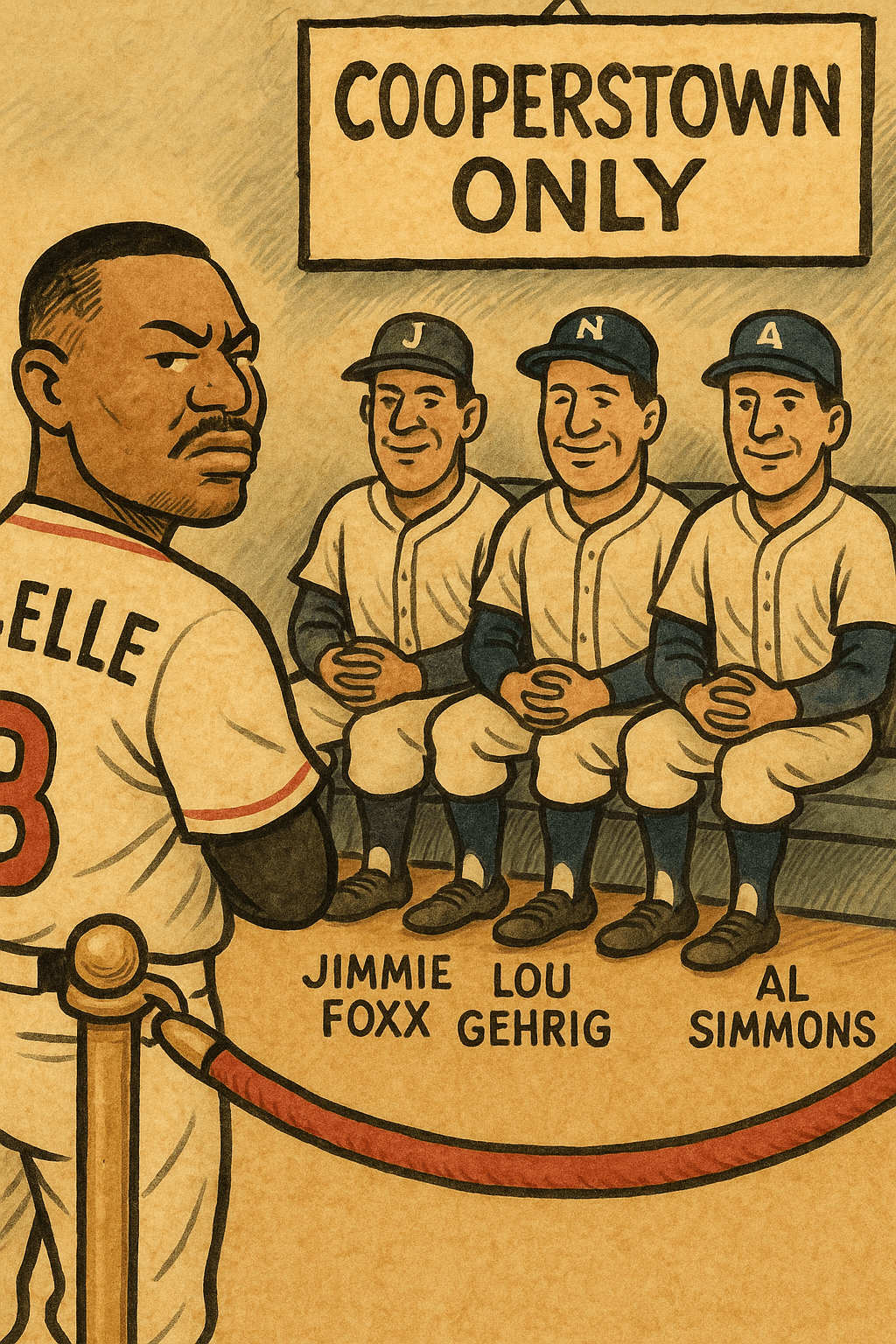
- Jimmie Foxx – 13 seasons
- Lou Gehrig – 13 seasons
- Al Simmons – 11 seasons
That’s it. That’s the club.
And then Albert Belle walked in like he owned the place. Because he kind of did.
Not Just a Streak—A Statement
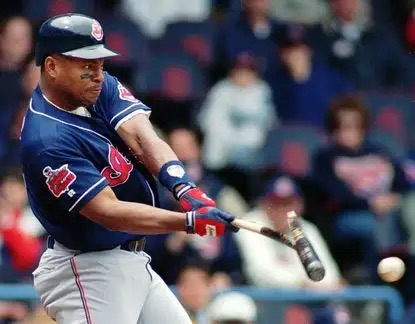
What makes Belle’s streak even more impressive is when it happened. This wasn’t in the 1930s when pitchers were tossing 82 MPH meatballs and outfields had the dimensions of an elementary school playground. Belle’s RBI tear ran through the teeth of the ‘90s—facing pitchers juiced to the gills, divisions thick with All-Star arms, and playing for multiple teams where he had to immediately become the offensive centerpiece.
He did it in Cleveland.
He did it in Chicago.
He did it in Baltimore.
Name a park. Name a uniform. Name a division. Didn’t matter. Belle just hit.
Nine Years of Pain for Pitchers
Let’s walk it out:
- 1992: 112 RBI
- 1993: 129 RBI
- 1994: 101 RBI (in 106 games, during a strike-shortened season)
- 1995: 126 RBI (tied for league leader)
- 1996: 148 RBI (league leader)
- 1997: 116 RBI
- 1998: 152 RBI (league leader again)
- 1999: 103 RBI
- 2000: 103 RBI
That’s not a hot streak. That’s a whole-ass decade of destruction.
The Quiet Power of 100

In an age of launch angles and exit velocities, we’ve started to forget the elegance—and intimidation—of simple production. RBI aren’t perfect, sure. But if you’re putting up 100+ year after year after year? That means you’re hitting. And hitting when it matters.
People love to argue about what counts in Hall of Fame debates. OPS+? WAR? Intangibles? But here’s a tangible fact: only three players in MLB history had ever strung together as many 100-RBI seasons as Albert Belle by the year 2000. And all three are enshrined in Cooperstown.
Belle? Not even a sniff.
So Why Is Belle Still on the Outside?
You know the answer. It’s not the numbers—it’s the narrative. He didn’t play nice with the media. He didn’t give polished interviews. He didn’t smile for the cameras. He wasn’t the guy MLB wanted on cereal boxes.
But that doesn’t change what he did on the field. Numbers like these are supposed to transcend personality. They’re supposed to matter.
If Albert Belle had smiled more and hit less, he might have gotten in already.
Instead, he hit more than anyone not named Gehrig, Foxx, or Simmons—and got ignored for it.
The “Short Career” Myth
One of the most common knocks against Albert Belle’s Hall of Fame case is the notion that his career was too short. He played just 12 seasons, with 10 full years of production before a degenerative hip condition forced him to retire at age 34. But this critique conveniently ignores what he did during those years—especially the nine-year stretch where he drove in 100 or more runs every single season. Most players are lucky to do that once or twice. Belle did it nine times in a row, with no off years, no injury breaks, and no performance drop-offs. That kind of elite consistency isn’t just rare—it’s nearly unheard of.

The irony? Belle’s career is often labeled “too short” by the same writers who canonize players with sporadic peaks and valleys over 18-year careers. But longevity without dominance is just mediocrity stretched thin. Belle condensed a Hall of Fame career into a violent, blazing, relentless decade. His nine-year RBI streak is proof of that—a stat that doesn’t just show up in a table, but tells a story of unrelenting pressure applied to opposing pitchers year after year. If Belle had played three or four more mediocre seasons to pad his totals, would the perception change? Should it?
The truth is, Belle didn’t decline—he disappeared. He went out hitting .281 with 103 RBI in his final season. His numbers didn’t fade with age; his body failed him. That distinction matters. His exit wasn’t a slow fade into backup roles or farewell tours—it was abrupt, almost surgical. He didn’t have the luxury of hanging on. And yet, in the time he was on the field, Belle did what few others have ever done: dominate in a way that forced pitchers to change how they pitched entire lineups.
So when critics point to Belle’s “short career,” remind them that greatness isn’t always measured in calendar years—it’s measured in impact. And Albert Belle’s impact, especially across those nine unforgiving seasons, was massive, measurable, and historic. You don’t need 20 years to leave a legacy. Sometimes, nine will do.
Nine Seasons. One Legacy.
Nine straight seasons of 100+ RBI is more than a stat. It’s a litmus test.
You can’t talk about run producers without mentioning Albert Belle.
And if you try to tell the story of ‘90s baseball without him?
You’re doing it wrong.
 Albert Belle: The Original 50/50 Man
Leave a comment