Albert Belle wore number 8.
So here are eight unforgivable reasons why baseball fans, Hall of Fame voters, and sportswriters should never forget him—even though they’ve sure as hell tried.
He wasn’t just dominant. He was scorched earth. He wasn’t just feared. He was untouchable. And yet, somehow, one of the greatest right-handed hitters of the modern era gets treated like a historical footnote.
Let’s fix that.
1. He Had the Strongest Season of the Steroid Era — Clean.
In 1995, Albert Belle hit 50 home runs and 52 doubles—a feat that’s never been matched in Major League history.
Let that sink in.
Not by Bonds. Not by A-Rod. Not by Ruth. Not even close.
And he did it in a strike-shortened, 144-game season.
Belle’s Insane 1995
In the 1995 season, Belle:
- Led MLB in home runs (50)
- Led MLB in doubles (52)
- Led MLB in slugging (.690)
- Led MLB in total bases (377)
- Posted a 1.091 OPS
This wasn’t bloated power from artificial muscle. This was pure violence, crafted in the weight room and sharpened in the film room. And despite all that?
He didn’t win MVP.
Because…
2. The MVP Voters Punished His Personality—Not His Performance
Belle lost the 1995 AL MVP to Mo Vaughn by just 8 points (308 to 300) — despite beating Vaughn in nearly every major offensive category.
The difference? Vaughn was “likeable.” Belle wasn’t.
“A player’s ‘general character and disposition’ are among the criteria on which qualified writers base their vote.”
—Larry Whiteside, Boston Globe & Baseball Digest, April 1996
And THEN…
“Nice guys finish last? Not always.”
—Whiteside, arguing in favor of Vaughn’s win
Hmmmm. So Larry Whiteside of the BOSTON GLOBE went out on a limb and specifically said that voters should consider a players non-statistical aspects. And then was like, “Hey look everyone! Mo Vaughn wasn’t better ON the field but he was wicked cool off the field and REALLY nice to us! Yay MVP!!”
One writer left Belle completely off his ballot. Another dropped him to seventh place, enough to tip the result. It wasn’t about production. It was about control. And Belle refused to play the media’s game.
3. He Was the True Engine of the 90s Indians Dynasty
The 1990s Cleveland Indians were an offensive juggernaut—Lofton, Thome, Manny, Baerga—but Albert Belle was the detonator. In 1995, when they went 100–44, Belle led the team in:
- Home runs
- RBIs
- SLG
- OPS
And he did it while being intentionally walked a league-high 29 times. Opposing managers built game plans around avoiding him.
Mo Vaughn? He was the “heart” of his team.
Belle? He was the warhead.
4. He Was a Five-Time All-Star and Five-Time Top-10 MVP Finalist
Belle wasn’t a one-year wonder. From 1993 to 1997, he was a nightmare on repeat:
- 5 straight All-Star appearances
- 5 straight top-10 MVP finishes
- Led the league in RBIs 3 times (1993, 1995, 1996)
In 1998, he dropped 49 HRs and 152 RBIs in his first year with the White Sox. In 1999, he followed it up with 37 HRs, 117 RBIs, and a .297 average.
Want some more?
Albert is one of only three players in MLB history to have 9 consecutive seasons with 30+ home runs and 100+ RBIs.
The other two?
Babe Ruth
Jimmie Foxx
That’s it. And that’s through the 1994 strike and a career-ending degenerative hip disease. Belle never dipped below 100 RBIs once over that run—and he hit 30+ home runs every single year.
You remember Griffey. You remember McGwire.
But Belle? He outproduced both of them in key years—and with none of the marketing.
5. He Had a 12-Year Career with Hall-of-Fame Numbers
One of the laziest knocks on Belle is that his career was “too short.”
He played 12 full seasons. Longer than Ralph Kiner. Longer than Sandy Koufax. Longer than Kirby Puckett.
He finished with:
- 381 HRs
- 1,239 RBIs
- .933 career OPS
- 143 OPS+
And his WAR (40.1) is deflated by a brutal, stat-suppressing relationship with the media and early retirement due to a degenerative hip.
In his final full season (1999), he hit .297 with 37 HR and 117 RBIs.
In his final game ever? He collected two hits and an RBI. He walked off the field with a home run. The man left the field still raking.
6. He Was an Enforcer in a Sport That Punishes Its Enforcers
Baseball has always punished its enforcers—guys who refuse to smile for the cameras but handle business on the field. Belle was one of the last of them.
He didn’t make commercials. He made pitchers sweat.
“He was the most intimidating player in the league. People pitched around him in every situation.”
—Bud Shaw, The Plain Dealer, 1996
He wasn’t just protecting his numbers—he protected his teammates. He was a throwback. A hockey-style enforcer with a bat instead of gloves.
And baseball—run by soft PR arms and voting writers—hated him for it.
7. He Studied the Game Like a Quarterback
People assumed Belle was all power, no brain. That’s false. He was a relentless film junkie.
“If you beat him with a pitch once, he remembered it. You weren’t going to beat him with it again.”
—Bud Shaw, The Plain Dealer
He tracked pitchers’ tendencies, studied video late into the night, and developed counter-strategies based on sequencing. Think Peyton Manning with pine tar.
Belle wasn’t a wild masher. He was calculated violence. Bo Jackson without the finesse—but every bit of the vision.
8. He Was Never Linked to Steroids—And Still Out-Hit the Juicers
This one really matters.
Albert Belle was never named in the Mitchell Report.
Never linked to BALCO.
Never busted.
Never whispered about.
And he still out-slugged many of the guys who were juicing.
In 1996, he dropped:
- 148 RBIs
- 49 HRs
- .311 AVG
- .625 SLG
Compare that to Canseco or Sosa—Belle was cleaner, stronger, and statistically superior without the chemical edge.
He was the cleanest power hitter in the filthiest era.
And that fact alone should make him a Hall of Famer.
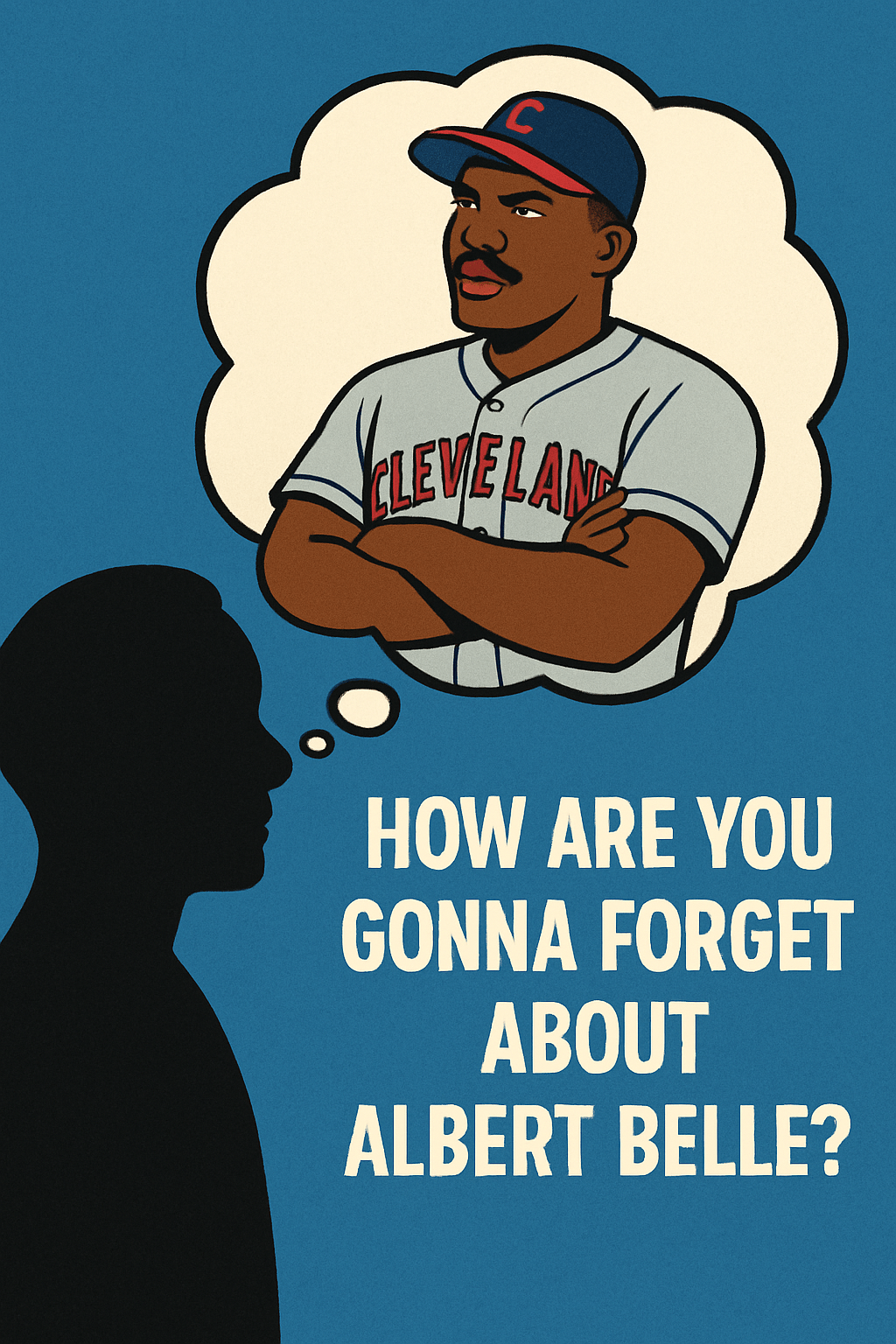
So How Are You Gonna Forget About Him?
Albert Belle was the most feared hitter of his generation. He wasn’t loved. He wasn’t polished. He wasn’t marketable.
But he was undeniable.
And yet:
- The MVP was stolen from him.
- The Hall of Fame dismissed him after just one ballot.
- MLB Network pretends he doesn’t exist.
- Sportswriters—many of whom admitted bias—controlled the narrative.
Let’s be blunt:
He didn’t lose. Baseball did.
“I didn’t care what people thought. I just wanted to win.”
— Albert Belle
Well guess what? He won.
 Albert Belle: The Original 50/50 Man
Leave a comment