In 1996, Albert Belle did something no professional athlete in North America had ever done.
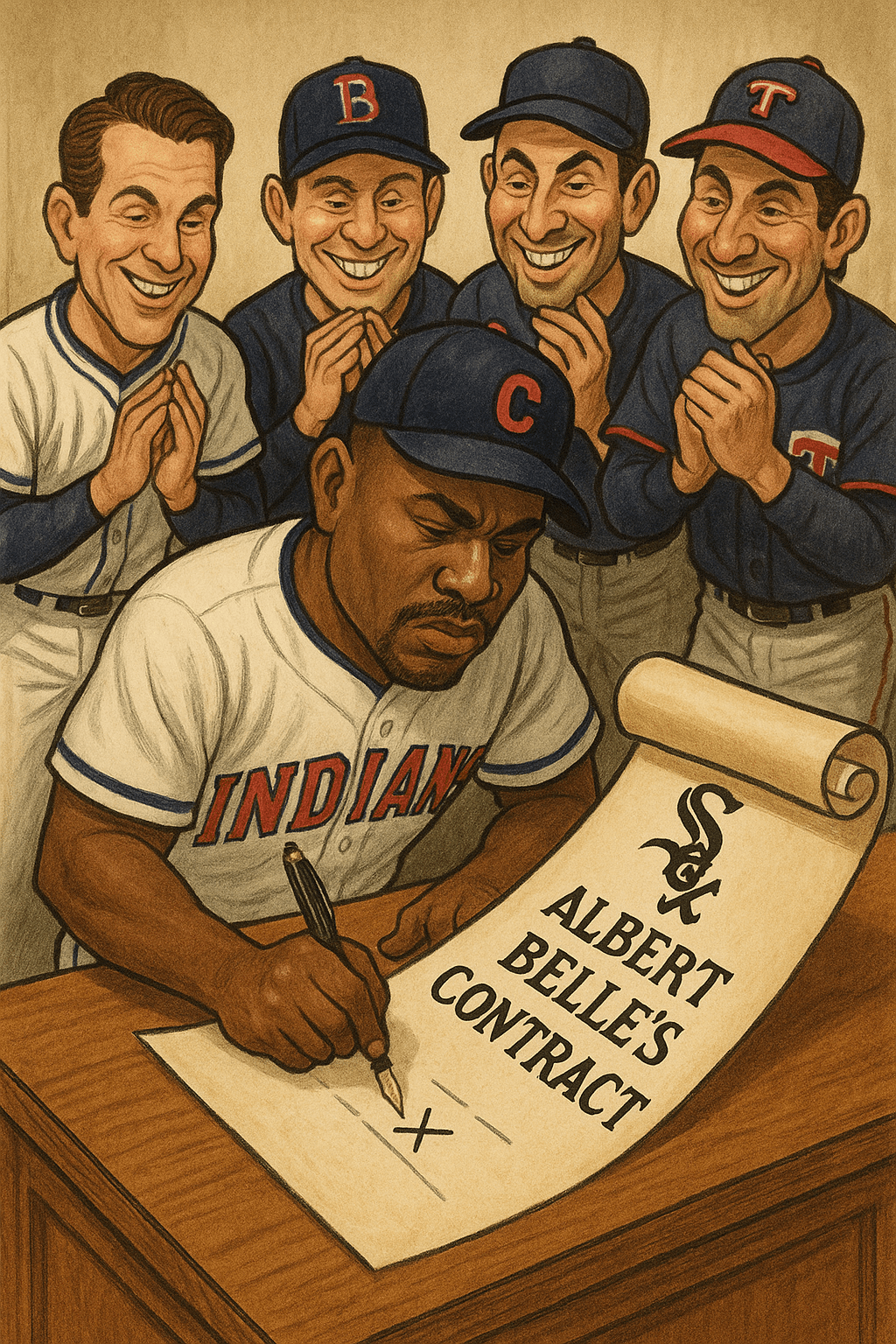
He became the first to cross the $10 million-per-year threshold, signing a 5-year, $55 million deal with the Chicago White Sox. It didn’t just reset baseball’s market—it reverberated across all of pro sports. Belle, who was coming off one of the most dominant offensive stretches in history, put a new price tag on athletic greatness.
And then?
He got erased.
This is the story of how Albert Belle changed the economics of sports—and how everyone cashed in on it except him.
The Contract That Shook Baseball
By the end of the 1996 season, Belle had racked up:
.311 batting average 48 home runs 148 RBIs 1.033 OPS
He was at the peak of his powers—and free agency was calling.
The Cleveland Indians refused to offer a no-trade clause. The White Sox didn’t blink. They handed Belle a 5-year, $55 million deal—the first ever to average $10 million a year.
At the time, it rocked the sports world. Players and owners alike understood: the market had moved.
What followed was a free-agent arms race built on Belle’s precedent.
The Dominoes That Followed
After Belle, the deals started climbing.
- Manny Ramirez: 8 years, $160M with Boston (2000)
- Jim Thome: 6 years, $87.5M with Philadelphia (2002)
- Alex Rodriguez: 10 years, $252M with Texas (2000)
- Kevin Brown: 7 years, $105M with the Dodgers (1998)
- Mike Hampton, Chan Ho Park, J.D. Drew—all scored massive deals built on the $10M/year floor Belle created
The real gut punch? Many of those who benefited most—PED users, media darlings, future Hall of Famers—got to play longer, smile more, and cash in harder.
Belle, who never failed a drug test and was statistically more dominant than nearly all of them, got shoved off the Hall of Fame ballot in two years.
A New Standard Across Sports: Belle Outpaced Jordan, Gretzky, and Rice
Belle’s contract didn’t just shake baseball—it put him financially ahead of every major athlete in North America at the time.
Here’s what top-tier icons earned in 1996:
Even Jordan didn’t eclipse Belle until the following season, when he signed his historic $30.14M one-year deal with the Bulls.
In that moment, Belle wasn’t just baseball’s financial benchmark—he was the bar for all of pro sports.
The Reputational Divide
So why don’t we remember him that way?
Because Belle didn’t play the game off the field. He wasn’t “good for the media.” He didn’t offer soft quotes or tolerate lazy questions. He didn’t shake hands or fake smiles. He was baseball’s apex predator—and he let everyone know it.
So when his hip gave out, there was no forgiveness tour. No “grit and grind” redemption arc. No second act.
He broke the system.
And then the system broke him.
What Does $10M Get You Today?
In today’s sports economy, $10 million doesn’t buy you MVP-level production.
In baseball, it gets you:
A .219-hitting platoon infielder A middle reliever with a 4.80 ERA A bench bat with “veteran clubhouse presence”
In the NBA, it’s a third guard or rotation wing.
In the NFL, it’s a starting safety or slot receiver.
In the NHL, it’s a top-line winger, maybe.
In 1996, $10 million got you Albert Belle—a walking thunderclap with 50-HR, 50-2B power. In 2024, it gets you a flyer on a guy who might OPS .700.
That’s not inflation. That’s the legacy of the market Belle created.
Everyone Got Paid—Except the Guy Who Changed the Pay Scale
Thome got his payday.
Manny got his fortune.
A-Rod rewrote financial history.
Albert Belle?
He’s a footnote. A punchline. A name that almost no one associates with the economic revolution he started.
And that’s the ultimate insult.
Because without Belle’s deal, those comps don’t exist.
Without Belle’s leverage, the $100M club doesn’t open.
Without Belle’s production, the bar doesn’t move.
What We Choose to Remember
We remember Bryce Harper’s $330M deal.
We remember Ohtani’s $700M.
We remember A-Rod’s contracts, Trout’s extensions, Judge’s holdouts.
But the first to break the line—the one who shattered the ceiling and proved athletes could demand their true value?
We don’t remember him. Because he didn’t ask us to.
Albert Belle made the money real.
He set the standard, and everyone else raised their hand to get paid.
Final Word
Albert Belle wasn’t just the most feared bat of the mid-90s.
He was the first athlete in a major American sport to redefine what it meant to be compensated for greatness.
He made $10 million the new normal—and then got locked out of the clubhouse he built.
So the next time a 6th-inning setup man gets $11.5 million a year, remember:
 Albert Belle: The Original 50/50 Man
Leave a comment