

A player’s “general character and disposition” are among the criteria on which qualified writers base their vote
By LARRY WHITESIDE
The Boston Globe
Baseball Digest, April 1996
LEO DUROCHER used to say, “Nice guys finish last.”
Not always.
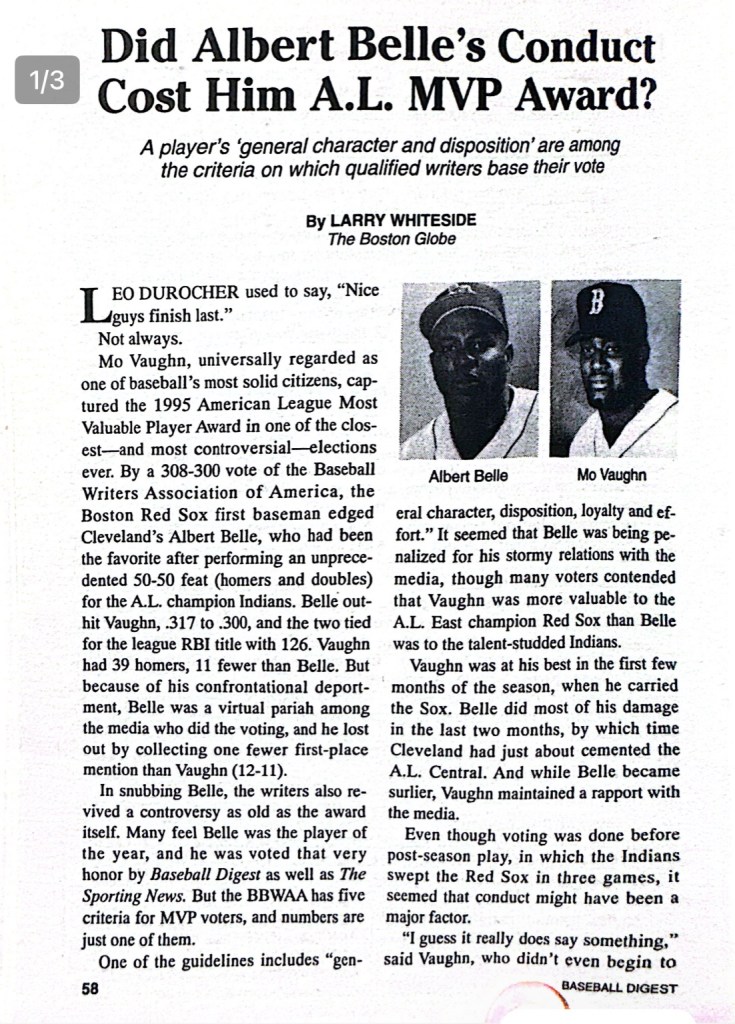
Mo Vaughn, universally regarded as one of baseball’s most solid citizens, captured the 1995 American League Most Valuable Player Award in one of the closest—and most controversial—elections ever. By a 308-300 vote of the Baseball Writers Association of America, the Boston Red Sox first baseman edged Cleveland’s Albert Belle, who had been the favorite after performing an unprecedented 50-50 feat (homers and doubles) for the A.L. champion Indians. Belle out-hit Vaughn, .317 to .300, and the two tied for the league RBI title with 126. Vaughn had 39 homers, 11 fewer than Belle. But because of his confrontational deportment, Belle was a virtual pariah among the media who did the voting, and he lost out by collecting one fewer first-place mention than Vaughn (12-11).
In snubbing Belle, the writers also revived a controversy as old as the award itself. Many feel Belle was the player of the year, and he was voted that very honor by Baseball Digest as well as The Sporting News. But the BBWAA has five criteria for MVP voters, and numbers are just one of them.
One of the guidelines includes “general character, disposition, loyalty and effort.” It seemed that Belle was being penalized for his stormy relations with the media, though many voters contended that Vaughn was more valuable to the A.L. East champion Red Sox than Belle was to the talent-studded Indians.
Vaughn was at his best in the first few months of the season, when he carried the Sox. Belle did most of his damage in the last two months, by which time Cleveland had just about cemented the A.L. Central. And while Belle became surlier, Vaughn maintained a rapport with the media.

Even though voting was done before post-season play, in which the Indians swept the Red Sox in three games, it seemed that conduct might have been a major factor.
“I guess it really does say something,” said Vaughn, who didn’t even begin to think of the possibility of becoming the MVP until after the season. “People are looking at the whole thing, and it turns out that it’s just not numbers. Still, I hope people understand I don’t want to get this award just because of what I do off the field. I’ve got to get credit for being a player. My numbers were right there with everybody. I really didn’t expect this.”
A.L. batting champion Edgar Martinez of Seattle received four first-place votes and was third with 244 points. Indians reliever Jose Mesa got the other first-place vote and was fourth with 130.
The eight-point margin in the 1995 A.L. voting was the ninth closest since the MVP Award was instituted in 1931, the closest since Willie Stargell and Keith Hernandez tied for the 1979 National League honor. Vaughn is the eighth Red Sox player to win the MVP, the seventh everyday player. Pitcher Roger Clemens won in 1986. In 1978, the MVP went to Jim Rice, now Vaughn’s hitting instructor.
Jack O’Connell, who covers the New York Yankees for The Hartford Courant, is the secretary of the BBWAA. He said his ballot listed Vaughn first, Cy Young winner Randy Johnson of Seattle second and Belle third.

“I’d like to think character didn’t make a difference in my vote,” O’Connell said. “But it could have. Subconsciously, it might have.”
Vaughn said the voting was out of his hands, and didn’t diminish his sense of accomplishment. He was so excited when he got the news he declined a press conference at Fenway Park in favor of one at the Harvard Street Neighborhood Health Center in Dorchester, home of the Mo Vaughn Youth Development Program, one of several community activities in which he is involved.
“It’s great,” said Vaughn. “It’s good for everybody. I couldn’t have done it without my team. It’s something I can hold and keep forever. I think it’s good for the city. I’m excited. And those who know me understand I don’t get excited very often.
“That Albert had 50 home runs and 52 doubles is tremendous. Edgar had a good year, too. But we all had good numbers. I’m just starting to realize what I’ve done.
“I thought I had a chance. It’s not something you set out to do at the start of a season, or any season, for that matter. I feel good about it.”
History often repeats itself. The tightest A.L. MVP election also involved a question of popularity when Joe DiMaggio beat Ted Williams, 202-201, in 1947. Williams won the Triple Crown that season but was left off the 10th-place ballot by a Boston writer who did not like Williams.
“It’s important to have character,” Vaughn said. “And to be considered the best at the major league level is tremendous.
“You don’t think about it. To receive this honor is unbelievable.”
Vaughn appreciates what others did to help him succeed.
“Jack Clark,” Mo pointed out. “Whether he was good here or not, he did a lot for me personally. Willie McGee. Sitting next to an MVP (in the N.L.) and listening to what he had to say. And Roger Clemens, who is close to me. They all helped me.”
But no one in baseball means more to Mo Vaughn than an individual known as the “Hit Man.”
“Mike Easler is probably the biggest reason I won this award,” Vaughn commented. “He’s not here now, but when he left (as Red Sox hitting coach), he knew the skills he had given me in those first couple of years would carry me through. I probably should split the thing in half and send the other half to him.”
1995 A.L. MVP RACE BY THE NUMBERS

Numbers in bold led or tied for league lead.
(*Italics and green shading added by author for clarity.)
CRITERIA USED IN VOTING FOR MOST VALUABLE PLAYERS
THE FOLLOWING LETTER that accompanied the MOst Valuable Player ballot was mailed to each voter by the Baseball Writers Association of America:
Dear Member: There is no clear-cut definition of what Most Valuable means. It is up to the individual voter to decide who was the Most Valuable Player in each league to his team. Also, just what Most Valuable means. The MVP need not come from a pennant winner or other playoff qualifier.
The rules of voting remain the same as they were witten on the first ballot in 1931:
1. Actual value of a player to his team, that is, strength of offense and defense.
2. Number of games played.
3. General character, disposition, loyalty and effort.
4. Former winners are eligible
5. Members of the committee may vot for more than one member of a team.
You are also urged to give serious consideration to all your selections, from 1 to 10. A 10th place vote can influence the outcome of an election. You must fill in all 10 places on your ballot.
Keep in mind that all players are eligible for the MVP, and that includes pitchers and designated hitters.
Only regular season performances are to be taken into consideration.


 Albert Belle: The Original 50/50 Man
Leave a comment